Showing posts with label AS level. Show all posts

Wednesday, 2 May 2012

Evaluation - Audience

Evaluation - Distribution

Evaluation - Representation


In my original photographs, the model was Jessica Emmerson and she was going to be used for the contents page photo or maybe the front cover. She was wearing casual clothes; beige jeans, yellow jumper and boots. I took them against a normal wall - which turned out to be a bad idea because it was difficult to cut out - using mainly close up shots of her. Her pose was relaxed, but since they were close ups, it was mainly of her face, which I took some of her smiling or just quite serious. I didn’t think it would represent the kind of social group I am aiming for, so I had to take more photos.


However, I decided to change my model and try different poses with them; they were still against a white background but their clothing was more feminine. The model I used for my front cover was Isla Johnston and she was wearing a pink skirt – which is a typical colour for a young, pop magazine – and a black vest top with red lipstick. She was standing with her hand on her hip, smiling and since the shots were medium-long, you could see the clothes and pose clearly. This photo is more suitable for the genre of magazine I am doing and follows the typical style of others like it, for example; Top Of The Pops. The photo is aimed at young, teenage girls who may be aspiring to look like her.


It represents a very stereotypical female gender, by looking sexy, confidence and attractive, reaching at to slightly vulnerable young girls. With the colours too, it makes it even more stereotypical, with the pink skirt and red lipstick both reaching out to the bubblegum pop genre. Her pose is much like others you would see on magazines like Top Of The Pops:


Monday, 30 April 2012

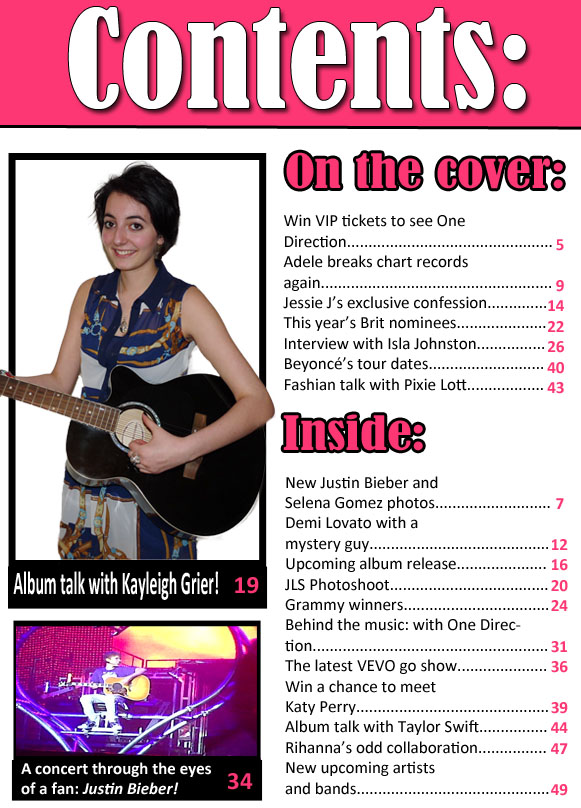
Completed contents page

Now, I have changed the photo to a one where she is smiling and looks happier, and is actually looking at the camera - which gives the impression she is drawing the audience in - it is now completed.

Friday, 13 April 2012

Second contents page attempt

With the photos added to the side and the captions underneath, my contents page is complete. However, I do not like the photo of the female used because she seems unhappy and isn't even looking at the magazine. So, I will be changing that but other than that I am happy with the way it looks.

Unfinished contents page 1

Now I have the story lines and headlines placed the way I want them on the page, I need to fill in the blank spaces at the side. So what I have chosen to do is add photos on the side. 
I have still stuck to the same house-style as what is on the front cover. Same colours and fonts being used, so it is easy to tell it belongs to the same magazine.

Finished magazine cover

Now I have added all that needed to be added, I am pleased with the outcome. It is clear to see the masthead and read the hooks and writing. There aren't too many hooks to make it looks crammed and the layout is the way I want it. There aren't too many colours which would overpower the magazine altogether.
And compared to the first attempt, I think this one is a great improvement and looks a lot better. It looks more eye-catching and with the model looking at the camera, it's like she is looking at the readers, drawing them in.

Unfinished magazine cover

This is my unfinished magazine cover. All that needs to be added is the small details like price, date, barcode etc... along with a box along the bottom with an advertisement or competition.
I chose to go with this photo because it's a typical pose what you would see on a pop magazine cover.

Tuesday, 27 March 2012

First attempt of the Article.

This is another plan of my article, however I changed the fact of having two small photos, and decided to have 1 photo taking up a full page and a small photo on the 3rd page. Also, the colour scheme changed to match the front cover and contents page. And i kept the idea of having a quote, but I had it on the 3rd page, again in the same style as the magazine title. I changed the same intro at the top to make it more bold, so it stands out.

First attempt of the front cover.

This was the previous cover I was going to use, but I decided the photo wasn't right and neither was the layout. So, I took more photos and completely changed the layout and colour scheme of it all. However, the title and fonts are the same as I did like those. The pose on this photo didn't look right and I didn't like how the main hook and small intro was centred.
I ended up with the front cover below.

Monday, 27 February 2012

Magazine Questionnaire

1) Age:

12-14 15-17 18-20 20+

2) Gender:

Male Female

3) Do you buy music magazines? If no, skip to number 7.
_____________________________

4) If so, which one(s)?
___________________________________________________________________________


5) How often do you buy a music magazine?

Weekly Fortnightly Monthly Sometimes
Rarely Other: ________________

6) How much do you usually spend on a music magazine?

£1-£2 £2-£3 £3+ Other:_____________

7) What do you usually look for when purchasing a music magazine?

Competitions
Brand of the magazine
Favourite band/artist
Posters or freebies
Other: _______________________

8) What genre of music do you prefer?

Pop
Rock
Hip-hop & Rap
Classical
Dance
Grunge
Garage
Metal
Folk
RnB
Jazz
Other: ___________________________

9) Who are your favourite top 3 artists/bands?
______________________________________________________________________________________________________________________________________________________

10) How often do you listen to music?

Everyday Every few days Not that much Never

11) How do you usually listen to your music?

Ipod
Phone
Itunes
Youtube
Radio
TV
Other: _______________

12) Do you download music?

Yes No

13) Do you buy CDs?

Yes No

14) What would you like to see more of in magazines?

Posters
Photo shoots
Gossip
New music
Concert reviews
Anything else? _________________________

15) What font do you prefer for the main texts?

Calibri (body) [ ]
Adobe Gothic Std B [ ]
Arial Narrow [ ]
Arial [ ]
Bookman Old Style [ ]
Tahoma [ ]

16) What colour scheme would you like on a magazine?
__________________________________________

17) Have you ever been to a concert?

Yes No


18) Did you purchase any merchandise? If so, what was it?
______________________________________________________________________________________________________________________________________________________

Tuesday, 24 January 2012

How is gender portrayed in the opening sequence of ‘Sugar Rush’?

The representation of gender in the opening sequence of ‘Sugar Rush’ breaks the typical conventions expected by a specific gender, although it does also fit the conventions at the same time. It presents different stereotypes of the two genders, some being the feminine gay men to the masculine females.
The opening sequence begins at a fair ground, on the waltzer, with two teenage girls. This is seen as a typical teenage activity to do. The bright lights and loud music show that they are having fun; this combined with the fast edits shows the excitement of the two girls. The music playing is pop music, which is what teenage girls are expected to listen to. The fast edits give the impression that it is dream-like. When the two girls kiss, there is an extreme close up to show the importance of the shot. When this shot fades out along with the music, and the next scene fades in with the diegetic sound, and we realise it was just Kim’s fantasy. At this point, conventions have been broke, as it is not a stereotypical thing for a girl to dream about kissing her female best friend, whilst masturbating. Although she says it’s fine as it is the 21st century. This shows she is quite masculine, yet she has floral pattered bed sheets, which we assume was not picked by her.
When her father walked in, he is completely clueless to what his daughter was doing. This is known as a typical male thing, however in the next scene we see he is not the typical manly man, as he trying to do DIY but his wife downgrades him saying “we’re going to get a man in”, and he corrects her saying “I am a man” but she replies with “a real man”, which suggests she does not think he is a man and that he is incapable of doing male activities. We assume the dad is not respected in their family, as if he isn’t actually the man of the family, because when Kim mimics him, we can see she is being sarcastic and he is constantly repeating the same thing.
In this same scene, where they are all in the kitchen, we see a lot of different representations of gender. One being the mother, and by this part we see that she is not the typical mother, as she does not want to be called “mum”, so she isn’t reminded of her motherly responsibilities. And she is also drinking which is usually the man thing to do. This breaks the conventions. In fact, it is like the mother and father is in reverse roles and she is the ‘man of the house’.
We next see another male representation, being two feminine gay men. They are the typical gay man, with their language such as; “he’s a darling”, this is usually a womanly thing to say, which makes them fit the conventions of a gay man.
The voice over is in a one-tone, drone voice which is how a stereotypical teenage girl would be known as talking like.
Finally, in the last scene, Marie Sweet or ‘sugar’ is introduced. Her character is in contrast to Kim’s. Firstly she is presented as being a flirty, seductive teenage girl, with the biting lips and her tone of voice saying; “Kick ass baby”. Then there is the clothing she wears, which is tight and revealing. Sugar dresses and acts the way a man would want her to act. The close ups on her legs and cleavage suggest she is flirty. In this scene they are playing pool which is usually a masculine game for girls to play.
Overall, in the opening sequence of ‘Sugar Rush’, there are many different stereotypes of the male and female gender, either breaking or fitting the conventions.
Successful media products depend as much upon marketing and distribution to a specific audience, as they do upon good production practises.

To what extend do you agree with this statement?
- Use case studies to support your answer.
- Franchises.
- Institutions.


I agree with the statement that marketing and distribution is just as important as production in making a film successful to the point, where it is important for DVD and BluRay release, but the production of the film has to be good for it to be successful in cinemas.
With companies like Disney and Sony being vertically integrated with other companies, they make production easier and better. Sony bought Columbia Pictures in 1989, this meant any sub companies that Columbia owned at that time, were now owned by Sony. Therefore, Sony could still produce their own films, with the help of Columbia Pictures. They could still use the equipment to make the films. This would lead to them releasing the movies on BluRay and DVD’s, which would be played on Sony equipment, giving them an even larger profit. With them being vertically integrated, they can ensure that their films will do well in the chain of cinemas they own. Sony further bought out a previous music company, making it Sony Music Entertainment, and would feature artists or bands on Sony films. Spider-Man is a good example of this, as synergy was used to release video games and soundtracks from the film, by them doing this they increased movie sales, and since the musician that sang the soundtrack was signed by Sony, they made money off that too. The first movie was so successful with production practises and the use of synergy, that it became a franchise. With two sequels and an upcoming fourth movie. This usually happens if the first movie is successful enough. Spider-Man is not the only franchise of films, in fact Harry Potter is the most popular one, each one getting more and more successful.
Although, while Sony distributed the films by using convergence. Such as social networking sites, this could have had a bad effect on the franchises, as people could post negative comments about the movie on Facebook or Youtube trailers, all used to promote the film. They were able to counteract this sort of thing with Slumdog Millionaire as Tug - a digital media agency was brought in to raise the awareness of the film in the UK - began promoting it on search engines to people who were interested in Pathé, India etc… this gained them 75,000 new visitors to the official Slumdog Millionaire site. Using convergence, they were able to promote the film on TV adverts as well as on the internet. All of this contributes to how well the overall success of the film goes. There were problems of piracy with Slumdog Millionaire, so to prevent this, they released the film to DVD and BluRay quicker. At first, it was going to be released straight to DVD without even going into cinemas, but with the funding of large companies like Pathé and Celador Films, they were able to use vertical integration and put the films in the wide cinema chains they owned. Viral trailers were used to market the film which was on AddictTV, then Danny Boyle asked them to create another one with sounds and images of the movie for the web. The Slumdog website used flash technology, again like the trailers, pictures and downloads were also available.
Monsters is another example of how convergence is used, as Foursquare set up ‘infected zones’ where users could have the chance to win merchandise off the movie. This had a great impact on movie sales, as it was getting the users excited for it.
Viral marketing takes a huge role in all of this, as it’s how the fans and viewers find out about the movie. Although there were the negatives about using social networking sites, there were positives too. The fact that fans could be updated on the movie. For example, Paranormal Activity had a button which would give people the option to get the film shown in their cinemas/areas. This builds the audience up to what they expect.
Overall, I think that the distribution of film is slightly more important, because even though the quality of the movie is very important, none of it would be worth it if it didn’t get promoted well enough.